
Bulk Grain Storage
Safe storage · moisture & pest proof · long-term quality
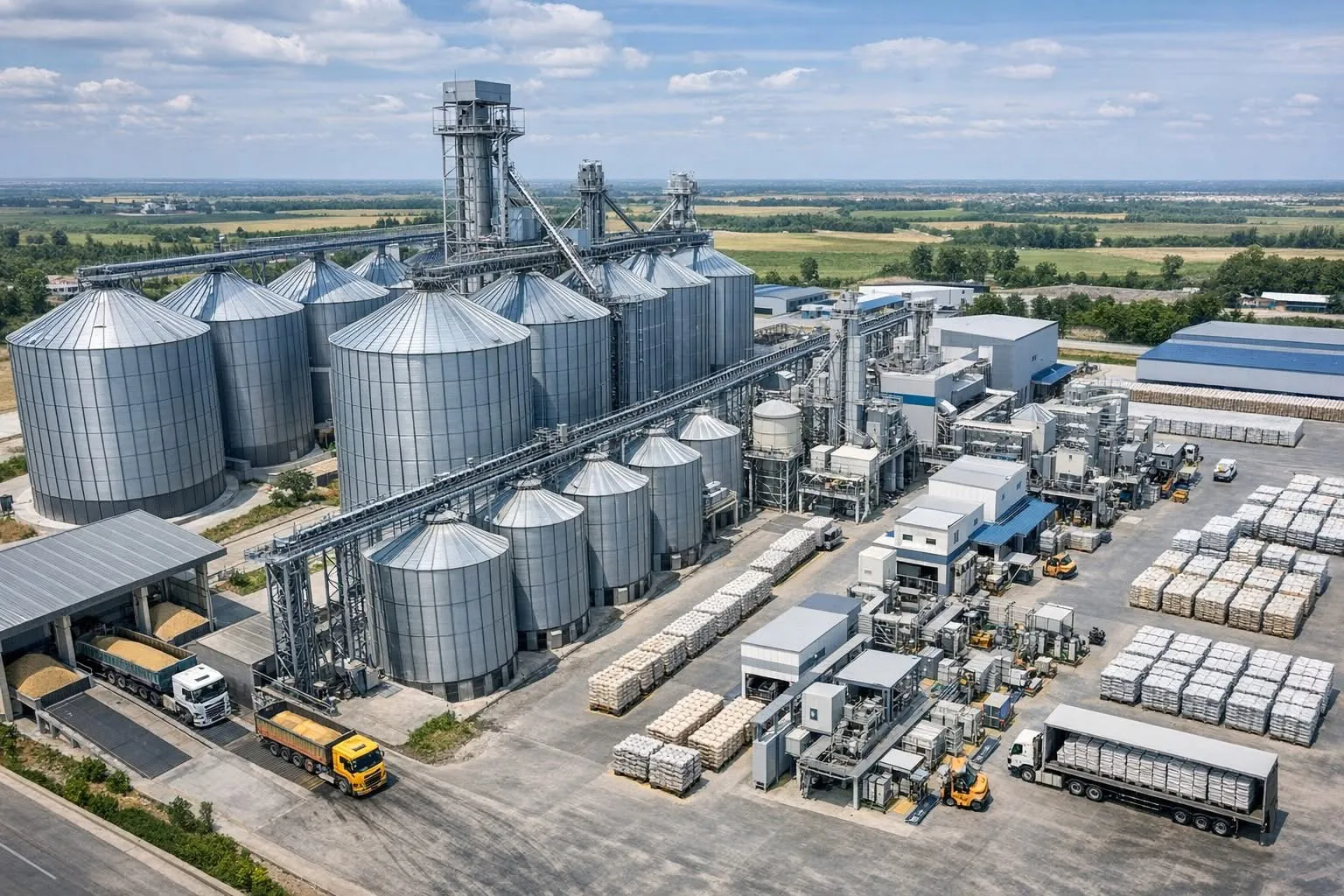
Challenges in grain storage
Long-term bulk storage faces multiple risks: moisture rebound causing mold, day-night temperature swings causing wall condensation, pest and rodent damage, and local "hot spots" triggering spontaneous combustion. A sound storage plan must be designed across three dimensions, silo selection, temperature-controlled ventilation, and automated loading/unloading, not just picking a silo.
Silo selection guide
Flat-bottom steel silo
Large single-silo capacity (500–10,000+ t)
Lowest unit storage cost
❌ Needs mechanical cleaning (sweeping auger)
For: long-term bulk storage, low-frequency turnover (1–2 cycles/year)
Cone-bottom steel silo
Gravity discharge, no cleaning equipment needed
Fast unloading, suited to frequent turnover
❌ Smaller single-silo capacity (50–300 t)
For: raw-material silos at processors, high-frequency turnover silos
Square steel silo
Square structure, maximizes site space
Can be mounted flush to walls and corners
Modular assembly, expandable as needed
❌ Needs auxiliary discharge device
For: in-workshop installation, processing by-products / feed raw materials, space-limited sites
Core auxiliary systems for storage
Temperature-controlled ventilation
Multi-point temperature cables monitor in real time + automatic ventilation/dehumidification. In-silo temperature difference held within ±3°C, fundamentally preventing condensation and "hot spots". Mobile remote monitoring optional.
Automated loading/unloading
Bucket elevator + scraper conveyor + belt conveyor combination, sized to the silo group. Full automation from truck unloading to silo storage, reducing labor dependence.
Protection & fumigation
Silo reserved with phosphine fumigation port, bottom moisture barrier + roof waterproof seal. Insect screens and rodent guards build a physical + chemical dual-protection system.
Silo capacity planning reference
| Scenario | Recommended total capacity | Recommended silo type | Recommended number |
|---|---|---|---|
| Small farm | 100–500 t | Mainly cone-bottom | 2–4 silos |
| Medium cooperative | 500–2,000 t | Flat-bottom + cone-bottom mix | 3–6 silos |
| Large collection center | 3,000–10,000+ t | Mainly flat-bottom | 4–12 silos |
Bulk corn storage
Storing corn specifically? Our corn silo page covers sizing by harvest volume, aeration and monitoring for long-term corn keeping.
Need a custom storage plan for your project?
Tell us your storage volume and site conditions, and our engineers will design the most rational silo-group configuration.