
Turnkey Grain Drying Plants
High Drying Capacity
50–1,000 TPD continuous or batch drying lines
Flexible Energy Options
Gas, diesel, biomass, coal or steam
Precision Moisture Control
PLC automation with ±0.5% moisture accuracy
Grain Quality Protection
Multi-stage tempering with low breakage
Why Choose AmGrainTech Drying Plants?
- Tailored drying plants for your harvest scale: from farm-level drying centers to large grain terminals handling corn, rice, wheat, soybean, and sunflower.
- Advanced drying technology: Multi-stage tempering, mixed-flow or cross-flow designs ensure uniform drying and low energy consumption.
- Flexible heat sources: Choose from gas, diesel, biomass, or even waste heat – we adapt to your local energy economics.
- Intelligent control: PLC with online moisture monitoring ensures precise drying, preserving grain quality.
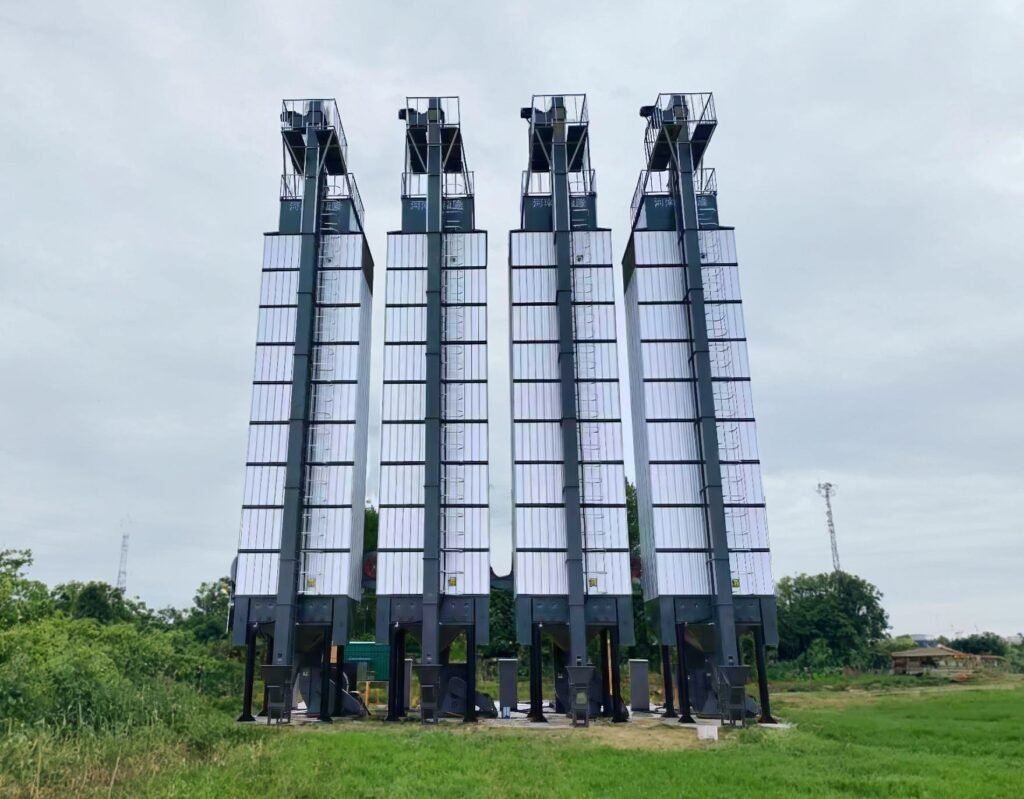
Capacity & Model Selection Guide
Suitable for rice, maize, wheat, soybean, and other cereals.
Our drying systems can be configured for a wide range of capacities, from regional grain drying centers to large commercial grain terminals.
| Scale | Capacity (TPD) | Recommended Model | Heat Source Options | Typical Application |
|---|---|---|---|---|
| Small / Farm | 100–150 TPD | 5HL-100 / 5HL-120 | Gas, Diesel | Individual farms, cooperatives |
| Medium / Regional | 200–300 TPD | 5HL-200 / 5HL-300 | Gas, Biomass, Coal | Grain stations, large cooperatives |
| Large / Industrial | 500–1,000 TPD | 5HL-500 / 5HL-1000 | Gas, Biomass, Coal, Steam | Ports, large grain reserves, feed mills |
| Seed / High-value | Batch (20–50 t/batch) | 5HX series (recirculating) | Gas, Diesel (low-temp) | Seed companies, specialty grain |
Typical Grain Drying Plant Process Flow
A typical grain drying plant integrates cleaning, drying, tempering, cooling, and storage to ensure safe long-term grain preservation.
1
Receiving & Pre-cleaning
Grain is received, weighed, and passed through cleaners to remove straw, stones, and fines.
2
Continuous/ Batch Drying
Grain flows through the dryer with precisely controlled hot air; moisture is reduced in stages.
3
Tempering (if applicable)
Grain rests in tempering bins to allow internal moisture to balance, preventing stress cracks.
4
Cooling
Dried grain is cooled by ambient air to safe storage temperature.
5
Storage or Transport
Cooled grain is conveyed to silos for storage or directly loaded for transport.
Key Equipment Used in This Plant
High-performance machinery engineered for durability and efficiency.
- 5HL Series Continuous Dryers (50–1,000 TPD) – High-capacity tower dryers for continuous operation.
- 5HX Series Recirculating Batch Dryers – Gentle drying for seeds and high-value grains.
- Flexible Heat Sources – Gas, diesel, biomass, or coal-fired hot air furnaces.
- Conveying Systems – Bucket elevators, screw conveyors for smooth material flow.
- Intelligent Control System – PLC with online moisture monitoring and remote access.
Typical Grain Drying Plant Investment Range
Estimate your budget based on scale and configuration.
- Small / Farm scale (100–150 TPD): $50,000 – $150,000
- Medium / Regional (200–300 TPD): $150,000 – $400,000
- Large / Industrial (500–1,000 TPD): $400,000 – $1,000,000+
- Seed / Batch systems: $30,000 – $100,000
Note: Final quotation requires a detailed site assessment and engineering design.
Applications of Grain Drying Plants
Grain drying plants are widely used in grain storage centers, rice mills, feed mills, grain terminals, and seed processing facilities. By reducing grain moisture to safe storage levels, drying systems prevent mold growth, maintain grain quality, and enable long-distance transportation and long-term storage.